








Li’l Musings – The aftermath of the Preventing CSA talk
(This article was submitted by Mr. George Mathew who is the CEO of a new-age preschool chain based at Trivandrum called “The Wonder Years Preschool”. The author is a researcher on child development and can be contacted at george.mathew@thewonderyears.co.in. For more details please visit http://www.thewonderyears.co.in)
A couple of days back I got a visit from one of my clients, parents of a child who had been part of my Summer Camp. The moment I saw them, I knew there was something amiss. I tried to read their faces – confusion, anger, relief, sadness, betrayal, hope – a host of emotions were playing on their faces.
We sat down in my office and after the usual pleasantries I asked about the purpose of their visit (especially since their child had gone back to school after enjoying the Summer Camp thoroughly). They gingerly said they wanted to thank us for saving their child’s life!
Now it was my turn to be surprised and have a host of emotions on my face!
As it turned out, the child had benefited a lot from a talk I give to our Summer Camp kids.
Every year, as part of Summer Camp activities, I give a talk to the kids (usually 6yrs+) on how to recognise ‘Bad Touch’ by an adult and what to do in case something like that happens to them by following a set of very simple instructions – NO, GO, TELL.
The parents narrated how their child had recently been subject to such a situation by someone very close to their family. This explained the emotions on their faces. It makes it so much more difficult to accept when we know the perpetrator so well but that was exactly what happened. All my paternal instincts were fired up. To think that this innocent child, who I happened to know so well, had to go through something like this was beyond me.
But fortunately, because of the talk, the child was able to think straight and escape from the place and promptly inform the parents. Of course, the parents made sure that the monster would not be in contact with their child anymore.
If not for that talk, this child would perhaps not have known what to do and how to react. For me, it was such a relief to know that nothing untoward had happened and that the child is happy and content knowing that the parents are there to protect in any situation.
I’m sad that such monsters still exist in our society … but I’m glad that at least my set of summer campers is safe from such predators.
This is why we all exist, right? To take care of our children, to see to it that they get the best life they can hope for, and remain happy and playful throughout their lives.
God bless our little ones…
Links to the talk on our Youtube channel
Li’l Musings – Selecting Your Child’s School
(This article was submitted by Mr. George Mathew who is the CEO of a new-age preschool chain based at Trivandrum called “The Wonder Years Preschool”. The author is a researcher on child development and can be contacted at george.mathew@thewonderyears.co.in. For more details please visit http://www.thewonderyears.co.in)
It was the year 1998. I had finished my 12th grade and had attempted the entrance exams for my Engineering studies. As per my wish, I got the admission call from one of the top colleges in the state. Obviously I was elated and my parents, quite frankly, heaved a huge sigh of relief.
The D-Day for admissions arrived soon enough and I, along with about 300+ other prospectives, huddled into one of the halls. All of us were just happy to be there… to get a good enough score to help us get into the streams that we wanted.
All except one – a chap called James.
He was at the Principal’s office interviewing the Principal!! I kid you not… this was actually happening!! James wanted to know why he should join this college instead of some others of equal repute (mind you, this was in 1998 when there were all of 11 Engineering colleges in Kerala and ours was ranked No: 2). Eventually James joined our college and went on to win a lot of awards from MNCs (Microsoft, SUN, etc.) at ages 19 – 20.
Now, why am I telling you this story? To illustrate the importance of interviewing your child’s school, rather than it being the other way around.
I know for a fact that when parents come to enroll their children in my preschool they ask a lot of questions – on methodologies, curriculum, activities, care, etc. And I love that, by the way. I love talking to parents and allaying their fears about sending their children to a preschool. Because I believe in the concept (so much so that my 6 month old baby is already in my school for 2-3 hours daily).
But the same people, when it comes to choosing their child’s school, do not do the same due diligence. In most cases, the attitude is “let me get admission for my child in so-and-so school, we will think of everything else later.”
Granted, the number of seats in good schools is low when compared to the number of applicants. But that does not mean that as a parent sending your precious little one to a school, you are stripped of your rights.
No. You should interview the school, the teachers, the Principal and make sure that it is the right fit for your child. Do they really have the facilities that they claim in their brochure? Do they really have the results they are advertising? Or is it just the top 3-5 kids getting the result while the rest of the kids falter?
You need to ask these and many other tough questions before enrolling your child in the school. And if their answer is that it’s none of your business or you need to join the school since your child can’t get admission elsewhere, then that right there is a definite and compelling reason not to choose that school.
You also need to check with parents of other children who already study there. Get as much insider information as possible. Get the good news… get the bad news. What is the school known for? Why did that parent choose that school over the others? What are its plus points? What are its negative points? As with all 3rd party information, take this also with a pinch of salt. Remember, the views of the parent, good or bad, will be highly biased.
One more aspect you have to think about is the transportation facilities offered by the school, especially if you stay far away from it. This needs to be thought in conjunction with other aspects offered by the school. You see, if you child is going to spend upwards of 1 hr each way daily in the bus, you better make sure the school is worth it. Do not select the school based on “prestige value”. What you need to be worried about is – Is your child going to gain as much in school as he loses in 2+ hours in daily commute? If the answer is Yes, then go for it. Else, rethink on the school.
After all, your child is going to spend his/her formative years, a total of at least 12 crucial years, at the school. You better make sure it is the right place for them.
Young Performers @Schoolkutti.com Children’s Library
Ms. Françoise Calvel of Layam Cultural Events and Training PVT LTD conducted a 10-day theater (drama) workshop for children from March 30 to April 10 at the Schoolkutti.com Children’s Library. The workshop provided an exciting opportunity for young performers to develop their skills.

How theater training helps kids
As well as having lots of fun using their imaginations and creating characters and stories using costumes and props, drama activities can help children learn about emotions and will help build self-confidence, improve communication skills, and develop teamwork and stage skills.
Attending theater classes help children/teenagers to respect themselves and also others. They also learn to manage their emotions and also find out how to express and practice self control. In addition, the learning of the numerous techniques of theater allows them to apprehend their body in space in a better way.
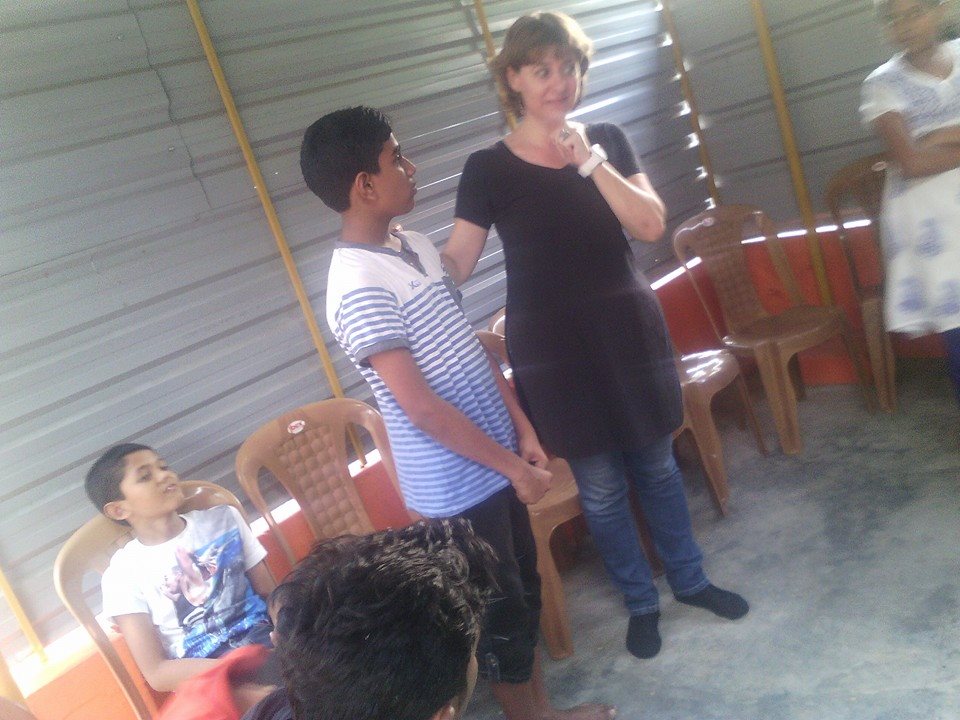
According to Ms. Françoise Calvel, the director of the play, the important aspects of acting is to understand yourself, to express your emotion, to create attitude and character. “For all that you must know how to control our body, so through several exercises, we work on body expression, clown, mask, and improvisation. Children learn that everything is coming from stomach: emotion, voice, reaction. Clown, mask and improvisation are only some techniques of performing arts.” – she says. It was interesting to note her point that the objective of theater training is not to remove shyness, but to know how to control it.

What they did
Children had fun experiencing the many aspects of theater as they developed skills and got in touch with their imagination. This is what Aysha Joyce, a participant of the workshop had to say about the camp – “We learned so many things like Attitude of a character, action and reaction, emotions, body language and a lot more. And all of us have new friends too. Thank you Françoise Calvel – A teacher with great energy and passion for theater.”

Topics Covered
The following topics were covered during the 10- day camp (2 hours per day).
– Occupation of space
– 5 senses, emotion bases
– attitude of character
– improvisation clown with dominant and dominanted
– creation of character paper mask
– how to create a story ? With action/reaction and problem.
– how to use the space, the group ?”
The camp ended with a performance for the families of children on the evening of the last day.

Li’l Musings – It really IS OK to fail!
(This article was submitted by Mr. George Mathew who is the CEO of a new-age preschool chain based at Trivandrum called “The Wonder Years Preschool”. The author is a researcher on child development and can be contacted at george.mathew@thewonderyears.co.in. For more details please visit http://www.thewonderyears.co.in)
Why is it that as a species we have this almighty aversion to failure? Is failure so bad that its very mention evokes hushed murmurs and seedy looks? Why is it that we don’t realize that success and failure go hand in hand? In fact, we fail and succeed umpteen number of times every day of our life. Don’t believe me?
OK , let’s do a simple mental exercise. Think back on your day and honestly write down your successes and failures. How many have you got? I got around 40 – 50 successes and failures each. Surprised? Finding it difficult to come up with even a few?
Why do you think that is so ? Well, it has got to do with how we define the terms success and failure.
The Webster’s Dictionary defines success (in this context) as “an event that accomplishes its intended purpose” and failure as “an event that does not accomplish its intended purpose”
So, in a sense, anything that we do (or do not do) can end in a success or a failure. Simple. For example, I am driving along and have to overtake a vehicle in front of me. If I do that, it is a success. If not, it’s a failure.
When we see things in this light, success and failure need not be that bad, right? In a way, failure is sometimes good. Going back to our example of overtaking cars, if I always try to be successful no matter what, I might end up in a bad crash. We need to let go sometimes.
I know this is over-simplifying things. But it is just to drive home the point that failure need not be all that bad and sometimes it is even desired.
This brings us back to the question – Why do we consider failure to be so bad?
I think it is because from a very young age we have been conditioned to think that failure is bad. Nowadays it is taken to such levels that some children do the unthinkable because they are unable to take the pressure.
We need to teach our children the difference between good and not-so-good failures. Good failures are the ones like the overtaking example. The not-so-good failures are the type we see in the big bad competitive world out there.
In the hyper-competitive world we live in nowadays, failure is scoffed upon… it’s taboo. But even here, what we need to teach our children is not to lose sight of the forest for the trees. We need to help them see the big picture. In the grand scheme of things, is 60% any worse than 90%? 10-15 years down the line, will it even matter?
I am not saying that we should not get our children to study hard. No, we need to encourage them to learn and understand the world around them, but at the same time we need to prepare them on how to deal with inevitable failure.
So why do children fail in certain areas? Maybe it’s not their area of interest. Maybe they did not understand the concepts as taught by their tutors. Maybe they temporarily had other things on their minds. The reasons could be endless and specific to each individual child.
Come on, let’s face it. Our children, however brilliant they are, are going to hit a roadblock sooner or later. Most of us face it at school level itself. Some parents teach their kids to look at the bigger picture and take it in their stride. They even help them see the not-so-apparent bright side of failure.
And this not-so-apparent bright side is what is most interesting about failures.
Most successful people will tell you that things did not go as per their original plan and they “failed” at it. But those failures would have made all the difference
.
Even I have many such stories of “failure”. When I finished my MBA program, I was interviewed for the post of Product Manager at Ibibo.com. After the interview, the panel promptly rejected me.
But that rejection meant that I got the opportunity to appear for BIG FM radio for the post of Cluster Head for Kerala. Eventually, I ended up thinking beyond a mere job and finally set up my schools. Looking back, I value that Ibibo.com interview more than the ones that selected me because at the end of the day, it made all the difference.
For if I was selected, I am pretty sure, with the salary package they were offering and the city I had to work in, I would never think of starting something of my own. So that rejection turned out to be one of the best blessings I have received.
Our kids will have failures… many failures over the years. Our job is to ensure that they are ready to face them when it hits. As parents, one of the most important things we can give our children is the confidence to experiment, fail, try again, fail, and repeat without having the fear of being ostracized or being rebuked.
If we can give them the confidence that, no matter what, we will be there to support them in their time of need, then we can watch them truly fly!
(Mr. George Mathew is the CEO of a new-age preschool chain based at Trivandrum called “The Wonder Years Preschool”. The author is a researcher on child development and can be contacted at george.mathew@thewonderyears.co.in. For more details please visit http://www.thewonderyears.co.in)
Li’l Musings- Like Parent, Like Child
(Posted by Mr. George Mathew who is the CEO of a new-age preschool chain based at Trivandrum called “The Wonder Years Preschool”. The author is a researcher on child development and can be contacted at george.mathew@thewonderyears.co.in. For more details please visit http://www.thewonderyears.co.in)
As a person running a preschool, I am often at the receiving end of the ire of parents and, particularly grandparents. Now, before you go off and jump to the conclusion that this is because of some neglect on our part, let me tell you, nothing can be further from the truth.
Mostly it is simple things like snacks not fully eaten one day (maybe the child was not hungry or not in a mood to eat that day) or dresses/shoes dirty (well, kids are kids; they are supposed to play and get their dresses/shoes dirty!) or the school van being 5 minutes late to pick up the child (our roads are not exactly designed for perfect timing during commute).
Don’t get me wrong. We love feedback. We love it that they take the effort to tell us because it is an opportunity for us to correct ourselves. What I have a problem with is how some of them put this across to us. Sometimes people can be very rude and hurtful while giving this feedback.
Now, as an adult, I can discern which of these feedbacks are constructive and which are not. I have the freedom to choose to accept some and reject others based on my assessment of the situation. But many a times these feedbacks are given in the presence of children and they might not be in a position to assess the situation like us adults. To them, it will be an example set by adults on how they should talk to others. And when they see the same pattern repeated over and over again, they will pick up on them and start behaving in a similar way.
In most cases, unwanted behaviour in children can be traced directly back to parents or other family members they are constantly in communication with.
Teaching children values is a very personal exercise. Most of us want our children to grow up as good human beings. The problem is, the definition of “good human being” itself is debatable. It is heavily linked to cultural and social backgrounds.
Who is a good human being? Someone who does not break the law? Yes, in the strictest form of the definition. Or is it someone who helps others? Again, yes. But the type of help matters. So definitions these are subjective.
To me, a good human being is someone who treats others with respect and courtesy, someone who will step up in the time of need to help a fellow human being. Those are the kind of future citizens I wish this country to have. Not ones who differentiate based on colour, creed, caste or social backgrounds. But invariably, by the way we act and interact, we teach our children otherwise. While we want our children to grow up as good human beings, we fail at setting good examples ourselves.
Remember, our children grow up watching us closely. Every action of ours affects their thinking. So if we want the best for our kids, it is high time we changed our behaviour to reflect that change.
(Mr. George Mathew is the CEO of a new-age preschool chain based at Trivandrum called “The Wonder Years Preschool”. The author is a researcher on child development and can be contacted at george.mathew@thewonderyears.co.in. For more details please visit http://www.thewonderyears.co.in)
Choose the right summer camp for your child at Trivandrum
Summer is almost here and that means school’s out and there is plenty of free time for our kids! Now is the time to look for opportunities for children to hone in their life-skills and enhance their cognitive and behavioral development. Summer camps take kids away from computers, TV, and video games, swapping them for group activities, fun, and games in a natural setting. Today, there are camps to meet every need, schedule and price range. You need to consider your child’s personality, interests and the options you have at hand before choosing the summer camp for your child.
We have attempted to collect and categorize all the Trivandrum based camps that have been announced for the summer of 2015.
http://schoolkutti.com/summer-camps/summer-camps-trivandrum.php
In this blog, we have tried to bring out the salient features of these summer programs that are coming up in the city, to make it easier for parents who are looking for the right camp for their children.
Fun, Games and Outings
The Wonder Years Summer Camp focuses on bringing back fun and games into summer camps through innovative activities, science experiments, challenges, frequent outings, trekking and camping trips. The basic idea behind their Summer Camps is for children to become independent, confident, pick up leaderships skills and work together in team exercises to develop collaborative skills.
http://schoolkutti.com/summer-camps/summer-camps-details.php?id=73
Wiggles Activity Center is coming up with outdoor and indoor activities for kids including football, karate, science, art & craft and a lot more.
http://schoolkutti.com/summer-camps/summer-camps-details.php?id=63
Language Development…
Ceed Academy offers a 6 months English speaking and grammer class for children from 10 to 15 years at SIP abacus, Vattiyoorkavu.
http://schoolkutti.com/summer-camps/summer-camps-details.php?id=82
Angloscape is combining yoga, personality development and other interesting activities with its communicative English program.
http://schoolkutti.com/summer-camps/summer-camps-details.php?id=68
Performance and other Activities
Castalia Activity Center provides the chance for children to perform in a mega show along with celebrities. They are planning more than 30 activities for children in the areas of art & craft, personality development, writing, reading and so on
https://www.facebook.com/CastaliaActivityCenter
Layam Cultural Events and Training PVT LTD is presenting a 10-day theater (drama) workshop for children from March 30 to April. As well as having lots of fun using their imaginations and creating characters and stories using costumes and props, drama activities can help children learn about emotions and will help build self-confidence, improve communication skills, and develop teamwork and stage skills. Class ends with a play or showcase on the afternoon of the last day.
http://schoolkutti.com/events/schoolkutti-events-details.php?id=53&districtId=1
Li’l Musings – Turn OFF that TV to Tune in to your child
(This blog is submitted by Mr. George Mathew, who is the CEO of a new-age preschool chain based at Trivandrum called “The Wonder Years Preschool”. The author is a researcher on child development and can be contacted at george.mathew@thewonderyears.co.in. For more details, please visit http://www.thewonderyears.co.in)
Vishal appeared tired and his eyes sunken. It was rather obvious he was troubled. His parents and grandparents constantly complained of his persistent negligence in studies, carelessness and diffident attitude.
As per his mother, Vishal spent most of his time in front of the TV. His friends were the characters that appeared in the cartoon channel. He behaved, spoke and acted like them. He ate, slept and breathed them every minute of his waking hours. Every school item was pasted with stickers and figures of these cartoon characters. It was something beyond addiction; it was obsession.
At an age when he ought to be talking about his classmates and friends, he spoke only about Ben-10 or Pokemon. At school he spoke only to those classmates who shared the common interest in terms of cartoon characters. Evidently, Vishal did not have any real friends. He only had virtual friends.
The situation is grim, and something that requires immediate attention. Vishal’s case is not unique. Sadly, we notice this story being played out over and over again all around us.
Is your child a member of virtual family?
Some parents seem to think that these tendencies will change over time while others accept it as a byproduct of the cultural and technological revolution our generations are going through. While urbanization and globalization taught us to limit ourselves to our own nuclear families, to become alone even in a crowd, are we not teaching our children to develop stereotyped virtual relationships with these cartoon characters from television?
10 to 15 years back we were not exposed to much of television. The biggest perceived problem back then was that sitting too close to the monitor would affect the vision. But today’s multimedia world makes the problem a lot more complex. It not only involves issues with visual acuity, but a range of behavioral problems stemming from over exposure to T.V. The series of behavioral problems include attention deficit, intolerance to real life situations, abnormal expectations from the friends etc.
The carefree moments that our children ought to be spending in sharing their lives with their friends, they live in an artificial world where their real life friends are aliens. The result is shrinkage of social-self and a lack of maturity in human emotions to meet the challenges of the world.
Does over exposure to TV produce attention deficit?
Excessive TV viewing can trigger many socio-psychological problems in the children. Children exposed to too much of TV in the early years might not develop the basic social skills required to survive and thrive in the complex world of multiple human characters. Such children can develop emotional blunting due to lower interaction with real people who exhibit a lot many more emotional and physical realms than cartoon characters.
The study reported by Dimitri Christakis, a pediatric researcher at Children’s Hospital and Regional Medical Center in Seattle, suggests that TV viewing in very young children contributes to attention problems later in life. According to the study “Each hour of television watched per day at ages 1 through 3 increases the risk of attention problems by almost 10 percent at age 7. This results suggest that those children who watched at least three hours of television per day were 30% more likely to have attention problems at age seven, compared to those who did not watch television at an early age.”
Attention Deficit Hyperactivity Disorder (ADHD) is characterized by the inability to focus, listen, and complete tasks and schoolwork at hand. Kids with ADHD act without thinking, are hyperactive, and have trouble focusing. They may understand what’s expected of them but have trouble following through because they can’t sit still, pay attention, or attend to details. All kids especially younger ones exhibit a number of fidgety behaviors, particularly when they’re anxious or excited. But the difference with ADHD is that symptoms are present over a longer period of time and occur in different settings. This cognitive dysfunction can inhibit the intellectual development of the child thus impairing a child’s ability to function normal in the social, emotional and academic spheres of life.
Brain changes associated with TV viewing
The first 2 years of a child’s life are considered a critical time for brain development. Through exploring, playing, and interacting with parents and others, the child becomes a part of the large social world. The American Academy of Pediatrics recommends that parents should not allow children under the age of two to watch any TV, while viewing should be strictly restricted to two hours per day those over the age of two.
One of the biggest problems with TV is that it can over stimulate and excite the brain. It has been found that the more TV children watch, the more likely it is for them to be impulsive, restless and have difficulty in concentrating. The reason for this is that unlike normal life where actions and events have continuity, TV is fast paced and the time spans are greatly sped up. The rapid scene shifts observed in the TV is not natural. Exposing a baby to such sudden and unnatural shifts can cause changes in the neuronal connections being formed.
When the scenes flash swiftly across the screen, the brain works hard to comprehend them. Because the temporal sequencing is so unlike real life or real time, the viewer is focused but not actually concentrating or comprehending. This phenomenon can lead on to develop a state of child’s impatience towards the impossibly slow real world compared to the artificial world created by the television. Scientists tell us that the brain develops in completely unique ways between birth and three years through the use of integrative functions of all sensory systems. As a baby sits “mesmerized” in front of the TV, neural paths are just not being created.
This early over-exposure to electronic media can hinder normal social emotional development in a child. As kids get older, too much screen time can interfere with activities such as being physically active, reading, doing homework, playing with friends, and spending time with family.
Most parents encourage TV viewing thinking that their children are gaining knowledge. Unless the programming is well thought through and designed to help your baby gain knowledge, this is not necessarily true. In most cases, programming is not designed to give the necessary and correct information to the child.
TV viewing and social behavior
Children who view violent acts on TV are more likely to show aggressive behavior. There are tendencies that these children imagine the world as scary and presume evilness to happen in their life. This leads to a situation where the children feel insecure and unsure about any new experience in life. This leads to a situation where the children will be scared and suspicious about new experiences that could affect the overall development of the child since he/she will not be able to assimilate the new experience in a way that will be useful to the child.
In TV, the “good guys” perpetrate many of the violent acts. These “Heroes”, who kids have been taught to emulate, paint a very different picture from what parents try to teach children. Even though the parents teach that it’s not right to hit, television says it’s OK to hit, or kick as a nature of good guy. This can lead to confusion when children learn to understand the difference between right and wrong.
Cultivate good TV habits
As mentioned before, the best possible solution is not to allow children under the age of two to watch any TV and viewing should be strictly restricted to two hours per day for those over the age of two. It will also be prudent to follow a few habits that will ensure that your child is not smothered by too much TV.
TV is NOT a family member:
Mealtime should be family time, especially dinner. This is the one meal where the entire family can sit together, discuss events and have a fun time. This interaction is crucial for the psychological development of the child.
TV time should be a privilege that is earned: Establish and enforce family TV viewing rules, such as TV is allowed only after chores and homework are completed.
Work while you work, watch while you watch:
Many times, parents would be watching their favorite programs on TV during the study time. What goes un-noticed is that children, instead of concentrating on schoolwork, spend their time listening in and watching the TV program. And if the child is “caught” catching a glimpse of the program, he is given a quick show down. But think of the child who is interested to explore the world suggests that the child is not to be blamed. It should be the parent’s responsibility to switch off the TV during study time. For most children, parents are their role models. So parents should be inculcating good TV viewing habits by setting an example of themselves.
Limit- a good start:
Schoolwork, sports activities, and job responsibilities make it tough to find extra family time during the week. Record weekday shows or save TV time for weekends and you’ll have more family togetherness time to spend on meals, games, physical activity, and reading during the week. Set a good example by limiting your own TV viewing. Select quality programs for viewing.
Provide unique alternatives:
Along with limiting TV viewing hours, stock the room in which you have your TV with plenty of other non-screen entertainment such as books, kids’ magazines, toys, puzzles, board games, etc. The possibilities for fun without the tube are endless so turn off the TV and enjoy the quality time together through game, start a game of hide and seek, play outside, read, work on crafts or hobbies, or listen and dance to music.
Take time to get organized: Select programs your family can watch together (i.e., developmentally appropriate and nonviolent programs that reinforce your family’s values). Choose shows that foster interest and learning in hobbies and education (reading, science, etc.). Preview programs before your kids watch them. Then, post the schedule in a visible area (e.g., on the refrigerator) so that everyone knows which programs are OK to watch and when. And make sure to turn off the TV when the “scheduled” program is ended.
Watch TV together
If you do decide to allow TV viewing make sure you do it together. If you can’t sit through the whole program, at least watch the first few minutes to assess the tone and appropriateness, then check in throughout the show.
Lock down that channel: More often than not, there is a limit to how much a parent of guardian can control the viewing time of the child. Most children clandestinely view their favorite channels when parents are away. This is even worse because for fear of getting caught, they turn down the volume and sit as close to the TV as possible leading to additional vision related problems. Most TVs and DTH boxes nowadays come with facility to lock down individual channels and even set timings when they are open. Make best use of this facility.
Talk to kids about what they see on TV and share your own beliefs and values. If you don’t talk to your children about the programming on TV, someone else will (or they will form their own opinions/conclusions about something they see). Engage with them on a conversation on what they see on TV. Use it as an opportunity to ask thought-provoking questions such as, “Is it OK for people to resolve issues through violence or war?” Or, “Is it Ok for girls and boys to be out at night for longer than needed?” If certain people are mistreated or discriminated against, talk about why it’s important to treat everyone fairly, despite their differences. You can use TV to explain confusing situations and express your feelings about difficult topics depending on the age of the child and what you think is appropriate for them to know at their present age on sex, love, drugs, alcohol, smoking, work, behavior, family life etc.
The information that comes through TV gives us a multisensory stimulation. The visual and auditory sensory channels get equally stimulated during TV viewing. This makes for easy processing of information for the viewer.
However, when information comes readymade, easy to wear and easy to handle, creativity in thinking and learning disappears. Qualities such as aspiration and perspiration for continuous success may not develop in its natural form. Children should be provided with opportunities to realize their capabilities along with the information poured in through TV. In essence, the knowledge gained through TV will get stagnant if children are not taught to channelize it properly.
TV does have its benefits. But early exposure to too much TV can cause devastating brain development problems. As parents we should take the higher ground here and for the sake of our children and their development, Turn OFF that TV to Tune into your child and his/her wonderful life
(This blog is submitted by Mr. George Mathew, who is the CEO of a new-age preschool chain based at Trivandrum called “The Wonder Years Preschool”. The author is a researcher on child development and can be contacted at george.mathew@thewonderyears.co.in. For more details, please visit http://www.thewonderyears.co.in)
Summer Programs @Schoolkutti
This summer, we plan throw open some fun filled communication building activity workshops for children from the ages of eight to fourteen years.
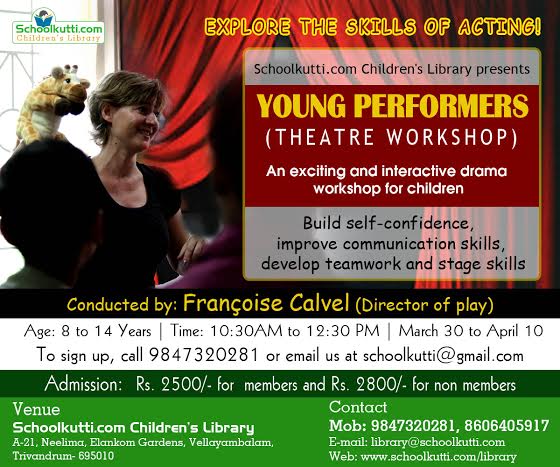
Young Performers(Drama/Theatre Workshop) – March 30 to April 10 (10:30 AM to 12:30 PM)
For the first time in Trivandrum, here is an exciting and interactive drama workshop for 8 to 14 year old kids conducted by Françoise Calvel (Layam Cultural Events and Training PVT LTD). As well as having lots of fun using their imaginations and creating characters and stories using costumes and props, drama activities can help children learn about emotions and will help build self-confidence, improve communication skills, and develop teamwork and stage skills. Class ends with a play or showcase on the afternoon of the last day.
Please click here to register
Register Online
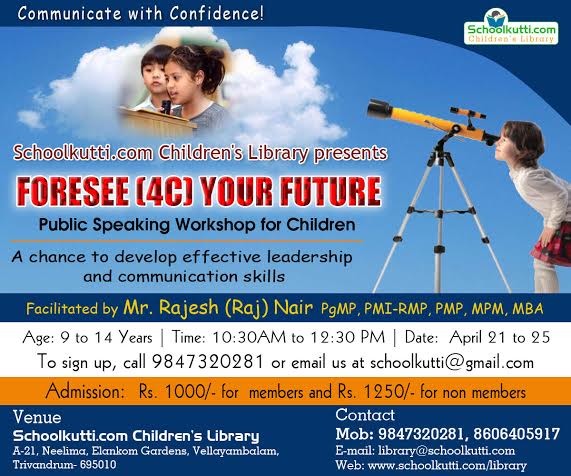
Foresee (4C) Your Future (Public Speaking Workshop) – Apr 21 to 25. (10:30 AM to 12:30 PM)
“Foresee (4C) Your Future” by developing effective leadership and communication skills. Are you afraid to speak in front of a group? How effectively you can use floor space?. How can you introduce story to speech? This workshop will help you quickly organize your points and present effectively to your audience. This will help you to improve communication in all parts your life. The program will be facilitated by Mr. Rajesh (Raj) Nair PgMP, PMI-RMP, PMP, MPM, MBA (Raj is a distinguished toastmaster (DTM) from toastmasters.org)
The workshop is a five days session of two hours every day that covers following areas.
-
Confidence at Lectern
Conquer the Floor Space
Carry Away Message
Characters in the Story
Putting it all together by practice sessions
Provide topic to students on which they can develop and deliver the speech for a quick evaluation for improvement areas
Question/answer session to clarify your doubts
Please click here to register
Register Online
Summer Camps a.k.a Slumber Camps
(This blog is submitted by Mr. George Mathew, who is the CEO of a new-age preschool chain based at Trivandrum called “The Wonder Years Preschool”. The author is a researcher on child development and can be contacted at george.mathew@thewonderyears.co.in. For more details, please visit http://www.thewonderyears.co.in)
Summer is just around the corner and that brings with it a big dilemma for parents with school going children – what to do with their free-spirited, active wards during the vacation time that spans 2 months? It is a dilemma that has no easy answers in today’s world.
For one, children nowadays are too worldly wise. They are too connected and know exactly what they want and do not want. What’s more, they are not afraid to speak their minds about it!
In the days of yore, (that is, when most of us reading this article were young) we used to wake up really early (as against schools days), rush out onto the fields or grounds surrounding our homes and spend the whole day playing to our heart’s content, many times skipping meals or just hogging on the hot snacks that one the mothers would bring out for us.
Ah… those were the days!
Secondly, many of us now live in crowded, concrete jungles where children have limited options. Even in the rare cases where they do have some space to play, elders of the locality will object to it due to various reasons like “The ball keeps getting hit into our compound”, or “They will break my window”, or “Kids scratched my brand new car”, or variations of all of the above.
One cannot blame them, for we live in communities where houses literally stick to each other or in flats where space is at a premium.
Thirdly, children have too many reasons nowadays NOT to play outside, what with all the distractions in the form of cartoon shows, movies, gaming consoles, internet, mobile devices, etc. These distractions bring with it a plethora of problems and issues associated with early child development (but that is a topic for a separate discussion).
So, this is where the concept of Summer Camps comes into focus. What are Summer Camps? Well, they are short-term “courses” run by schools, preschools, activity centers, sports clubs, etc., that aim to keep children engaged in productive activities thereby supposedly impacting children in a positive way.
Now, the effects of Summer Camps on children have been studied in detail and have been found to be net positive for children. Some of the benefits include:
– Making true friends
– Reconnecting with nature
– Developing life-long skills
– Spending their day being physically active
– Having free time for unstructured play
– Experiencing success and becoming more confident
– Learning social skills
– Learning independence
– Unplugging from technology
– Gaining resilience
So, if Summer Camps are so beneficial and fun, why is it that year in, year out,we keep hearing stories of how boring summer time was or what a waste of time it was, even from children who attended Summer Camps around the city?
Well, most often than not, it has everything to do with what is offered at these Summer Camps. If we look around, we will find that most Summer Camps are about music classes, dance classes, yoga classes, karate classes, skating classes, etc. Notice the pattern here?
Well, they are all some variation of “classes”. In our insatiable zest for “teaching” our children, we do not even leave them to themselves during vacation time. We heap another set of classes on their heads!!
The net effect is that children get thoroughly bored in the very first week of their Summer Camp!
What children need are not “classes”,but rather the opportunity to try new things, to experiment, to come up with ideas and to generally have fun. What our children need are real Summer Camps where children get to have lots of fun, where they get to make new friends, where they can participate in team activities, where they can go for trekking trips, where they can have a real, overnight camping experience.
The sad thing is many people do not realize the importance of free and unstructured play. Most see play as a “waste of time”. But in reality, it is the opposite. It will be through these experiences that children will develop a more outgoing and holistic personality. They will learn and pickup social skills that they might not get elsewhere.
So parents, what will be your choice for vacation activities for your children this year? Summer Fun or Slumber Zzzzzzz…?
(This blog is submitted by Mr. George Mathew, who is the CEO of a new-age preschool chain based at Trivandrum called “The Wonder Years Preschool”. The author is a researcher on child development and can be contacted at george.mathew@thewonderyears.co.in. For more details, please visit http://www.thewonderyears.co.in)
Summer Holidays
Blog posted by Mrs. Susan Mathew, of Friends PlaySchool and Kindergarten, Trivandrum
With the start of the summer holidays( some schools close as early as 1st week of March), parents may now be wondering how to organize and plan the day so their child isn’t at a loose end or glued to the TV. while it is important to see that they do join in some group play/learning, they should also be given some part of the day to do things on their own. How to get your child to play alone and quietly, without constantly begging you,”Play with me!”? It’s not only a teenager who needs his or her ‘space’; very young children too, need mental room.
Give them space. Even while you supervise their play and keep a constant eye on them, you can still afford them space. Allow your child time to think quietly and play alone. A child who can’t handle a second without outside stimulation needs to develop some attentive muscles, just as a less active child may need to exert himself or herself physically.
Creativity comes from constraints. Overloading our homes and yards with toys can have a crippling effect on our children’s imaginations. Set aside some time when they cannot use gadgets and PSPs – a “no screen day”. Allow them to dream and exercise their creative muscles. Let them to find ways to entertain themselves, rather than depending on you to suggest activities.
Don’t fuss about the mess. Hold your tongue when you see them trooping in the mud. There’s nothing a little soap and water can’t take care of. If you’re honest, you would be the first to admit that the best play usually involves dirt, sand, water and rocks.
A museum of everything. To gather objects is a natural compulsion. It’s not unusual to see children leave the kindergarten with something clutched in their hands or stashed in their pockets. Sticks, stones, dried leaves, bugs, and sometimes even sand can engage their fascination for hours. Collections kept outdoors are no big deal, but when they want to bring the outdoors, indoors- dedicate a shelf or tray to keep things neat and contained.
Dress them for play, not a wedding! Allow your children to wear clothes they can get dirty without worrying about grubby knees on pants, or ripped pockets. After all, would you go to the beach in a suit or a saree? Read this poem to revisit your childhood rambles in the long lazy days of summer.

The ability to occupy oneself is a life skill that is becoming less and less common and infinitely more valuable. What you do to encourage your child to acquire this skill would go a long way in giving him or her a lively interest in the natural world and an ability to balance an innate creativity with the demands of a technology driven world.